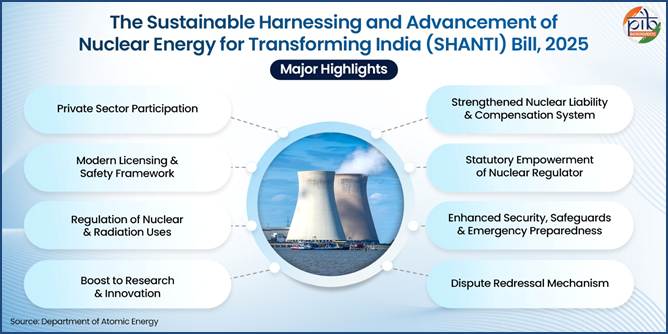
SHANTI Bill 2025 (Sustainable Harnessing and Advancement of Nuclear Energy for Transforming India Bill) was passed by the Indian Parliament in December 2025. India passes the SHANTI Bill 2025 to revolutionize nuclear energy. Learn how this law ends the state monopoly, introduces SMRs, and aims for 100 GW of power by 2047. It represents the most significant overhaul of India’s nuclear energy policy since the 1960s. What is the SHANTI Bill 2025? Key Provisions and Impact on India’s Nuclear Future.

Key Summary of the SHANTI Bill
The primary goal of the bill is to expand India’s nuclear power capacity from roughly 8.8 GW to 100 GW by 2047, helping the country meet its Net Zero climate targets by 2070.
Core Provisions
-
End of State Monopoly: For the first time, private Indian companies and joint ventures can build, own, and operate nuclear power plants. Previously, this was the exclusive domain of state-run entities like NPCIL.
-
Repeal of Old Laws: The bill replaces two major pieces of legislation:
- The Atomic Energy Act, 1962
- The Civil Liability for Nuclear Damage Act, 2010
- Statutory Status for AERB: The Atomic Energy Regulatory Board (AERB) is now a statutory body, granting it greater legal independence and accountability to Parliament for safety oversight.
- Focus on SMRs: It encourages the deployment of Small Modular Reactors (SMRs), which are easier and cheaper to build than traditional large-scale reactors and can be used for captive power by industries.
- Investment Caps: While opening to the private sector, the bill reportedly caps private and foreign equity at 49%, ensuring the government retains majority control.
Changes to Liability & Transparency
| Feature | Old Framework | SHANTI Bill 2025 |
| Supplier Liability | Suppliers could be held liable for faulty equipment. | Removed. Suppliers are generally protected to attract foreign vendors. |
| Operator Liability | Flat cap (e.g., ₹1,500 crore). | Graded caps based on reactor size and capacity. |
| Information Access | Subject to RTI Act. | Section 39 allows the government to “restrict” nuclear data from RTI. |
Major Criticisms
-
Safety Accountability: Critics argue that removing “supplier liability” makes it harder to hold equipment manufacturers (especially foreign ones) accountable for design flaws.
-
Transparency: Opponents have flagged Section 39 for potentially “institutionalizing secrecy” by exempting nuclear information from the Right to Information Act.
-
Cost to Taxpayer: If an accident exceeds the operator’s liability cap, the government (and thus the taxpayer) assumes the remaining financial burden.
PIB Information on Shanti Bill
As per PIB, At a time when India is reimagining the future of its energy landscape, a new legislative step has emerged to guide the country toward a more advanced and resilient nuclear ecosystem. The Sustainable Harnessing and Advancement of Nuclear Energy for Transforming India (SHANTI) Bill, 2025, reflects the government’s effort to modernize the laws governing the nuclear sector. It brings together various elements of nuclear development under a single, comprehensive structure, aiming to create a more streamlined and future-ready system.
The Bill focuses on a forward-looking approach and its role in shaping India’s long-term energy pathway. As a significant piece of legislation, it marks an important moment in the country’s broader journey toward building a secure and sustainable energy future.
- Planned Expansion: With the indigenous 700 MW and 1000 MW reactors being developed through international cooperation, the capacity is projected to rise to 22.38 GW by 2031–32.
The Sustainable Harnessing and Advancement of Nuclear Energy for Transforming India (SHANTI) Bill, 2025, stands as a pivotal step in shaping the next phase of India’s nuclear journey. By modernising the legal framework and strengthening institutional oversight, it creates the foundation for a more efficient, innovative, and secure nuclear ecosystem.
The Bill supports India’s long-term vision of expanding clean, reliable energy while ensuring that strategic interests remain fully protected. As the country moves toward greater energy independence and technological advancement, this legislation can play a defining role in driving the growth of India’s nuclear power and broader energy landscape.